Quiz: When Words Disappeared

Test your understanding of this case with 10 questions.

Progress0 / 10 completed
Case Information
Review the case details while answering questions

PATIENT DEMOGRAPHICS

76-year-old male

PRESENTING COMPLAINT

Acute onset difficulty reading. Patient reports 'letters or small words missing' and that 'reading did not make sense'.

EXAMINATION FINDINGS

Visual Acuity: OD: 6/6, OS: 6/6

Pupils: Equal and reactive, no RAPD

Fundus: Normal optic discs and retinal vasculature bilaterally

INVESTIGATIONS
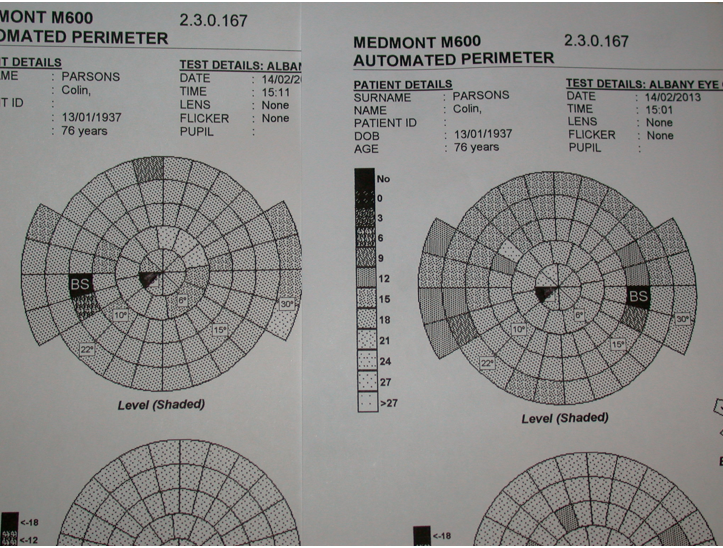
Humphrey 10-2 perimetry showing left homonymous inferior paracentral scotoma in both eyes

Humphrey 10-2 perimetry showing left homonymous inferior paracentral scotoma in both eyes

Central Visual Field Testing (Humphrey 10-2): Bilateral central 10-degree perimetry revealed the same scotoma in both eyes, consistent with a left homonymous inferior paracentral scotoma. This localizes to a lesion in the right occipital pole above the calcarine fissure.

Neuroimaging (CT/MRI Brain): Stroke in right occipital cortex above the calcarine fissure, corresponding to the visual field defect.

Question 1 of 10

The patient describes "letters or small words missing" and that "reading did not make sense." This description is most typical of which mechanism?

Question 2 of 10

A patient presents with acute reading difficulty, but VA is 6/6 in each eye and the optic discs appear normal. Which of the following best explains this discrepancy?

Question 3 of 10

Which feature most argues against giant cell arteritis (GCA) as a cause of this presentation?

Question 4 of 10

The 10-2 perimetry showed the same defect in both eyes. What does this suggest?

Question 5 of 10

What is the most likely diagnosis?

Question 6 of 10

Why does a lesion above the calcarine fissure cause an inferior, rather than superior, field defect?

Question 7 of 10

This patient initially presented to a GP who checked VA, found it normal, and reassured the patient. What was the critical error, and what should have been done instead?

Question 8 of 10

If neuroimaging confirms an acute occipital infarct, what is the expected pattern of visual recovery?

Question 9 of 10

What is the most appropriate immediate next step in management?

Question 10 of 10

How does this presentation differ from classic "alexia without agraphia" (pure word blindness), despite both sometimes being described as "reading difficulty" from occipital pathology?